


QUALITY & MAINTENANCE GUIDE
Maintenance of matt gilding (18k gold-plated – 3 μ): the sustainable guide
Beautiful gilding is not only a question of thickness, it is also a matter of daily gestures.
The Ylume signature? A champagne matte gilding in 18-carat gold plating (3 microns),
designed to reflect the light with softness. This matte finish — more subtle than a very shiny gilding — requires
specific maintenance habits to remain luminous over time. In this article, we gather all our
concrete tips: minute routine, do & don’t, cleaning, storage, travel, sport, and answers to frequently asked questions
. The objective: to extend the life of your jewelry and preserve its character.
chamois clothafter wearing, store in a separate pouch, and prefer slow and gentle movements.
These four reflexes are enough to make the difference.
Matt gilding: what changes compared to shiny gilding
On a piece of jewelry, “matte” does not mean dull: matte simply reduces bright reflections to
favor a diffused light. On the skin, this champagne light is very photogenic,
especially outdoors. On the other hand, as the matte finish is less “mirrored”, some micro-traces of
friction or oxidation related to everyday life can be perceived differently than with an ultra-polished finish.
Nothing to worry about: an adapted routine helps preserve this softness.
- Light : softer glow, natural chic.
- Perception of traces : friction can be seen in a way other than on a very shiny surface; Regular wiping is essential.
- Style : matt gilding is easy to combine with materials (linen, silk, knit) and sober colours (black, cream, denim).
A word about the composition (to understand the outfit)
Ylume jewelry is gilded in 18-carat gold-plated, 3 micron thick on a quality brass
base, without nickel, lead or cadmium. The thickness of 3 μ is an excellent standard of
High fantasy : it offers a real protective gold “cushion” compared to the very fine
gilding known as “fancy”. However, real durability is as much about your use as it is about the technique:
hot water, cosmetics, sports, shocks, sand, unsuitable storage act like tiny abrasives.
Avoiding (or limiting) them is key.
| Factor | Impact on gilding | What to do |
|---|---|---|
| Water (shower, pool, sea) | Surface leaching, limescale deposits, aggressive chlorine/salt | Systematically remove the jewelry before |
| Cosmetics & Perfumes | Greasey/acidic residue sticks and tarnishes over time | Apply before, let dry, then put on the jewelry |
| Sweating & Sport | Acidic pH + repeated | Avoid wearing during sports, wipe off afterwards |
| Friction & shocks | Micro-scratches, marks | Remove for risky tasks, store separately |
| Storage | Surface oxidation, scratches if loose | Individual pouches, dry place, away from humidity |
Quick Routine: 30 seconds that change everything
Before you go out
- Apply skincare products and fragrances.
- Let your wrists, neck and lobes dry.
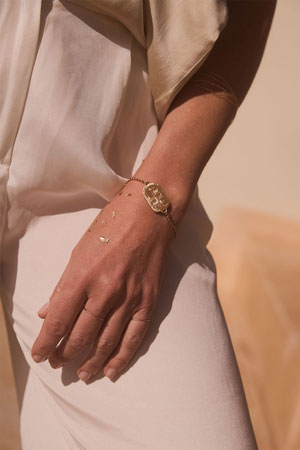
- Put on your jewelry last: hoop earrings, 45–60 cm medallion, bangle.
Perfume on the skin, not on the jewel!
On the way back
- Carefully remove your jewelry.
- Wipe a dry, soft chamois cloth (light movements).
- Store each piece in its bag or box, in a dry place.
This gesture is enough to limit 80% of visible marks.
“big cleaning”.Matte gilding likes softness and regularity.
Do & Don’t: 14 Reflexes to Adopt (and Avoid)
Do
- Put on the jewelry after care/perfume/makeup.
- Wipe quickly with a chamois cloth after wear.
- Store in an individual bag in a dry place.
- Alternate the pieces (let “breathe” for 24–48 hours).
- Take your time to open/close hoop earrings and to adjust a bangle.
- Travelling with a compartmentalized case.
- Remove for sport, housekeeping, gardening.
Don’t (to be avoided)
- Shower/bathe (sea, pool) with jewelry.
- Spray perfume on the jewelry.
- Store in bulk (rubs and scratches guaranteed).
- Clean with abrasive products (pastes, baking soda, toothpaste, silver, etc.).
- Use an ultrasound or chemical bath.
- Force the rods at a single point (risk of twisting the curve).
- Wear heavy pieces under a hat/scarf that rub for a long time.
Cleaning matt gilding without damaging it
Good news: the maintenance of a matt gilding is simple. Most of the time, a dry wipe is sufficient.
For cases where a slight greasy film has set in, follow these steps.
“Light” (occasional) protocol
- Prepare a clean, completely dry microfiber cloth .
- If necessary, barely moisten a corner of the laundry with warm ( not hot) water, without soap.
- Wipe with wide and very gentle movements, without insisting on a point.
- Finish with a complete dry microfiber.
This protocol is to be reserved for visible deposits. On a daily basis, stay on the dry chamois.
What to avoid at all costs
- Abrasive pastes and powders (baking soda, clay stone, toothpaste): they polish and can “polish” the matte.
- Ultrasonic or solvent baths: they attack the gilding and assembly glues.
- “Instant gloss” products for silverware.
The objective: to preserve the visual grain of the matte finish. Cleaning is not polishing.
If you have any doubts, refrain and return to the chamois.
Storage and travel: your jewelry safe
At home
- Use individual pouches (soft cotton) or a box with compartments.
- Store in a dry place, away from bathroom fumes.
- For trimmings, separate the chains to avoid knots (store with the clasp closed).
Travelling
- Choose a hard case that does not crush in the bag.
- Slide the pieces into individual bags before placing them in the case.
- Avoid carrying jewelry with you at the airport (security) to limit handling.
, leaving just the clasp protruding. On arrival, the chain is intact.
Seasons, sport, work: adapt the way you wear
| Background | Risks | Tips |
|---|---|---|
| Summer (beach & pool) | Salt, chlorine, sand, sunscreens | Remove before swimming, wipe after exposure, store as soon as possible |
| Winter (scarves, hats) | Long rubbing on lobes and collars | Prefer more discreet loops under textiles, wipe off on the way back |
| Sport | Acid sweating, shocks, traction | Systematically remove |
| Office | Repeated press on the desk (rushes), headphone/earphone rubbing (buckles) | Leave a light play on the wrist, favor mini-hoop earrings under helmet |
| Cleaning, gardening, DIY | Detergents, shocks | Remove jewelry and replace only once hands are cleaned and dry |
Troubleshooting: what to do if…
… Your curls look less luminous
It is often a film of products (cosmetics, hairspray, cream) or a skin deposit.
Start with a long, gentle chamois wipe. If necessary, switch to the “light” protocol with
a barely moistened microfiber, then dry thoroughly.
… a rush has been too far apart
Avoid going back and forth several times. Close slightly , holding each end in the palm, with very gentle,
distributed pressure. If the shape has been altered, stop all manipulation: the best option
is to contact us for personal advice.
… a chain has tied a small knot
Place it flat on a light surface, add a drop of neutral oil (optional), then untie with two thin pins
without pulling. Wipe down completely before storing.
Maintenance checklist (printable)
- ✔️ I put on my jewelry after perfumes and treatments.
- ✔️ I remove my jewelry for water, sports, cleaning.
- ✔️ I wipe with a chamois cloth after wearing.
- ✔️ I store in a separate bag, dry.
- ✔️ I travel with a hard case.
- ✔️ I adjust my rushes gently, by distributed pressure.
- ✔️ I limit prolonged friction (scarves, bags).
Why these tips really extend the life of a piece of jewelry
The durability of a gilding depends on a simple equation: thickness + use + storage.
The 3 μ thickness provides a solid base. The right gestures limit mechanical (friction), chemical
(water, chlorine, salt, detergents) and organic (perspiration, sebum, cosmetics) wear and tear. Individual storage prevents
micro-scratches from forming on contact. Add to that the choice of a matte champagne shade,
which is softer visually, and you have jewelry with lasting charm.
FAQ — Matte gilding, 18k gold plated (3 μ)
- Can I shower with my matte gold-plated jewelry?
- We advise against it. Water, soap, limescale and heat accelerate the wear of any gilding. Remove your jewelry before showering.
- Why wipe a “matte” piece of jewelry when it doesn’t shine?
- To remove deposits (cosmetics, skin, pollution) that gradually dull the surface. A gentle wipe helps keep the matt light even.
- Is the chamois cloth enough?
- Yes in 90% of cases. The “light” protocol (microfiber barely moistened and then completely drying) is reserved for visible deposits.
- Is Ylume jewelry suitable for sensitive skin?
- Yes: our gilding is nickel, lead and cadmium-free. In case of hypersensitivity, limit prolonged wear and clean contact areas regularly.
- What is the difference between “high fantasy” and “fantasy”?
- The high fancy uses a thicker and more qualitative gilding (at Ylume: 18k gold plated – 3 μ), while the “fantasy” is often satisfied with a very fine deposit. The thickness and the right gestures explain the hold.
- How to travel with necklaces without tangling them?
- Close the clasp, place the “U” necklace in a small bag, then slip it into a hard case. Avoid bulk.
- My gilding seems more sensitive in summer: normal?
- Yes: salt, chlorine, sand and perspiration increase friction and deposits. Be extra vigilant (removal before swimming, wiping, dry storage).
Extend the champagne matte light every day
Ylume creations are designed in Aix-en-Provence and gilded in 18 k – 3 μ gold,
matte champagne shade, for a soft and lasting shine.
Discover our selections:
Creoles,
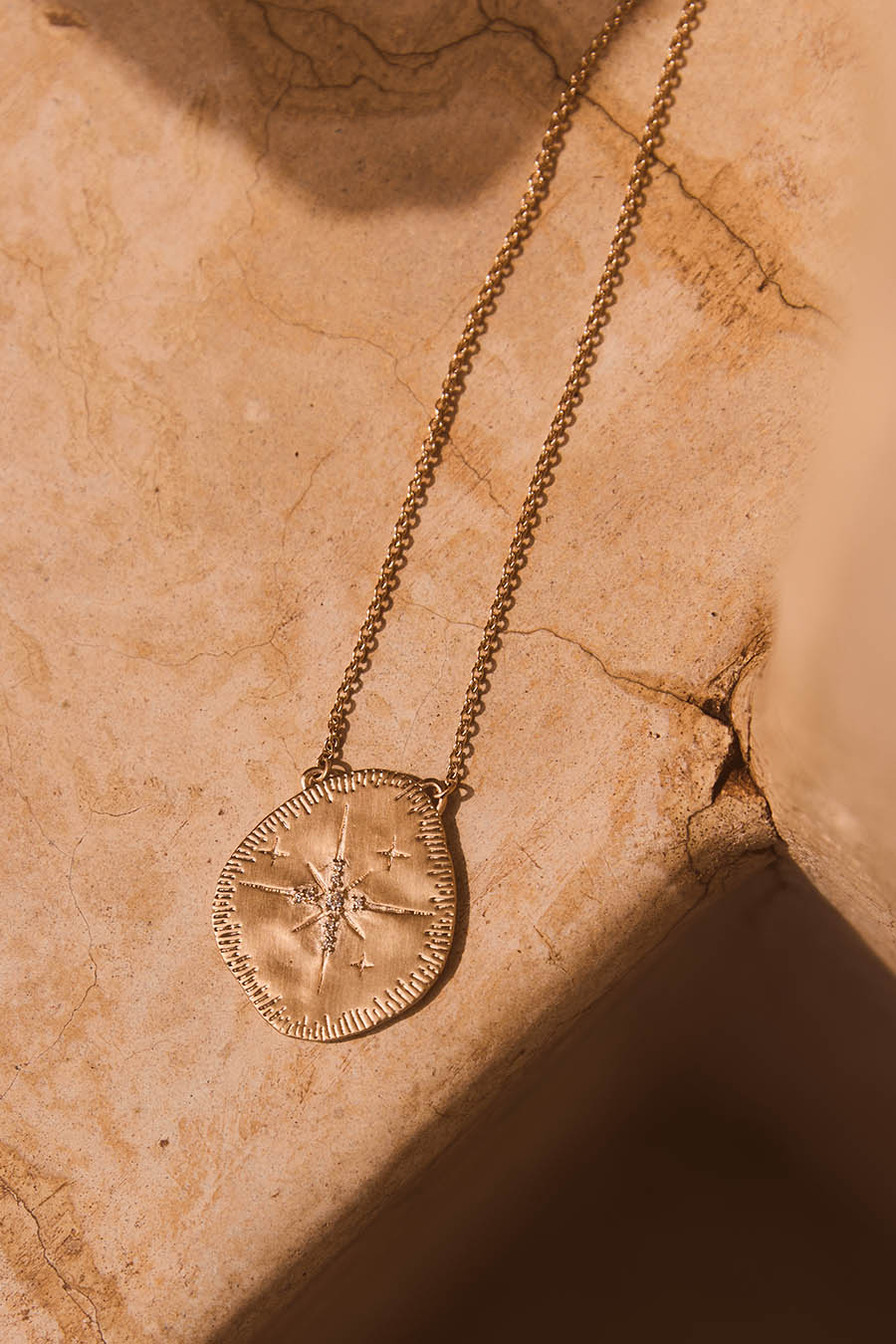
medal necklaces,
bracelets and bangles.
Want to go further? Check out our Gold Plated Jewelry Care page.